Domain vs. Hosting
Confused about domain names and web hosting? You're not alone. This simple guide explains the difference with a clear analogy and shows beginners exactly what they need to start a blog.
TOOLS & RESOURCES
10/4/20254 min read
Ever felt that moment of quiet panic when you hear "you need a domain and hosting"? You nod along, but a little voice in your head whispers: "I don't really get the difference... is this going to be too complicated for me?"
I know that voice well. For the longest time, I thought a domain and hosting were the same thing. The truth only hit me when I was building my first site and saw a "free domain" offered as a gift with my hosting. I was confused—why was it a separate gift if they were the same?
But the real psychological hurdle was thinking I needed to understand every single detail perfectly before I could even begin. That lack of clarity became my biggest excuse to delay. It felt huge and intimidating.
Then, I embraced a powerful lesson: you don't need perfect understanding to take the first step. You just need the courage to start. The moment I took action and built my second website, everything clicked into place. I finally saw how the domain and hosting worked together, and the fear vanished, replaced by the joy of creation.
If you're feeling that same confusion, I want you to know it's a normal part of the process. Let's clear it up right now, so you can move past the fear and into the fun part.
The Easiest Analogy You’ll Ever Hear
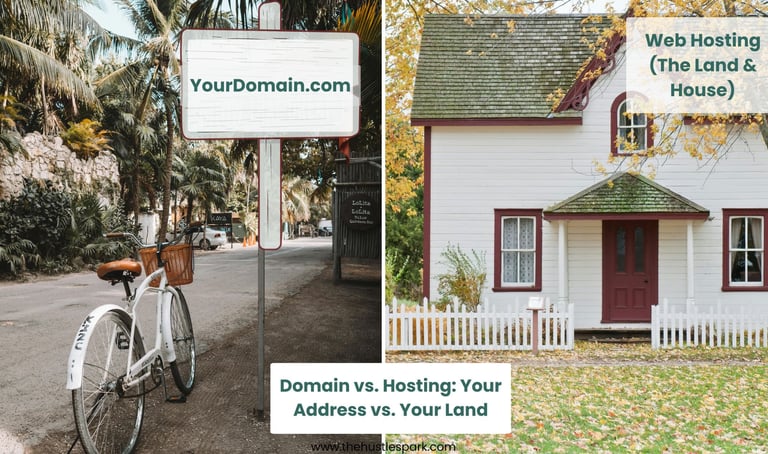
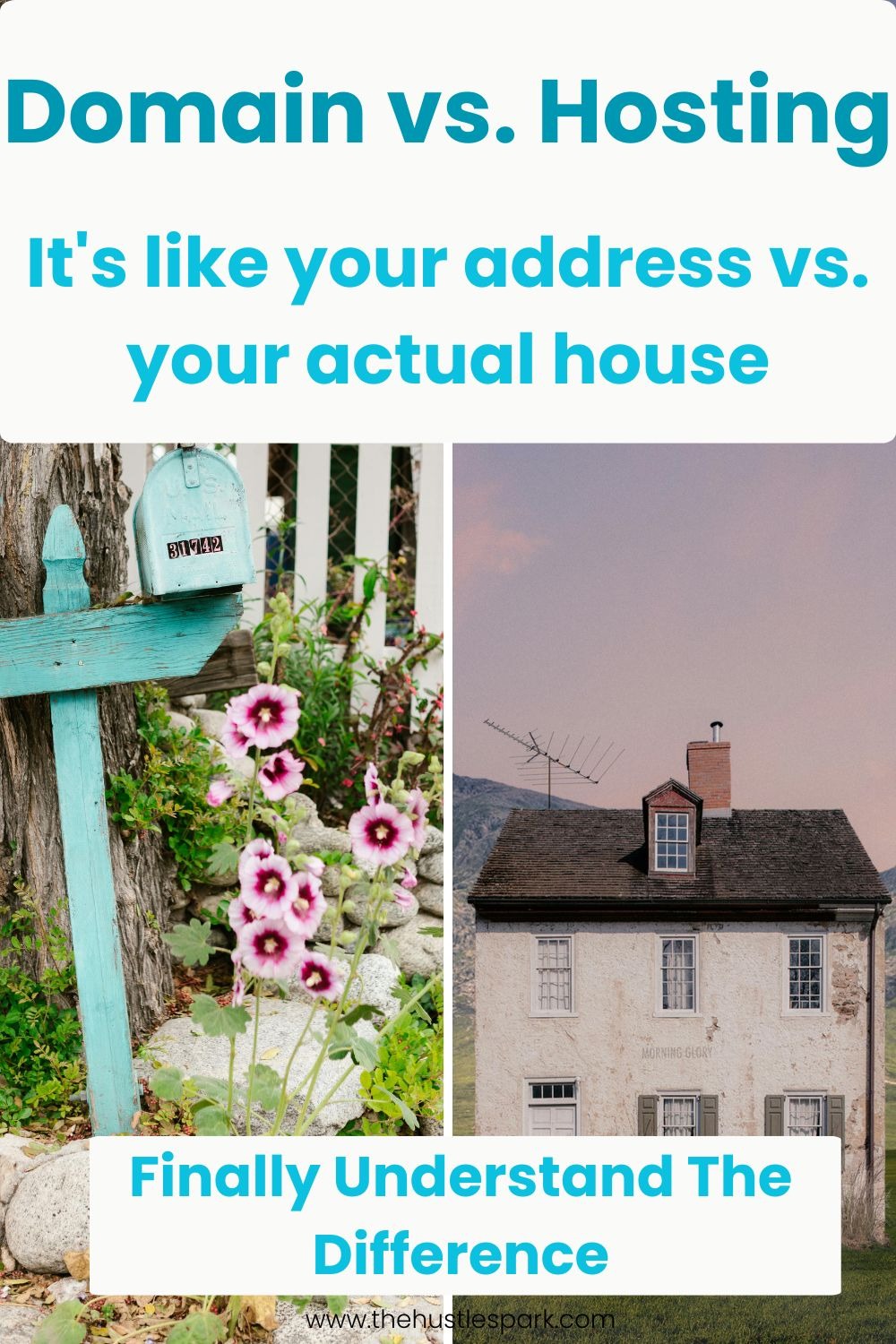
Let’s use a simple analogy: building a house.
Your Domain Name is Your Street Address.
This is what people type into their browser to find you (e.g., www.MyAwesomeBlog.com).
It’s the unique identifier that points people to your location on the internet. Just like an address, it doesn't contain the house itself.
Your Web Hosting is The Actual Land and House.
This is the service where all your website’s files, images, and code are stored.
It’s the physical space where your blog “lives.” Without it, you have an address that leads to an empty lot.
You need both an address (domain) and a plot of land with a house (hosting) to have a functional home online.
Diving a Little Deeper: What Each One Does
What is a Domain Name?
Think of the entire internet as a giant, global phonebook. Your domain name is the unique entry in that phonebook.
It’s for People: Domains are designed to be human-friendly. Instead of having to remember a complex string of numbers (an IP address like 192.168.1.1), you just remember YourBlog.com.
You Rent It: You don’t actually own your domain name forever. You register it and pay an annual fee to renew it, kind of like leasing a P.O. box.
What is Web Hosting?
If the domain is the address, the hosting is the plot of land, and the utilities that make it livable.
It’s for Storage: Hosting servers are powerful computers that store every single part of your website and serve it to visitors when they type in your domain.
You Pay for a Service: You pay a monthly or annual fee to a hosting company for the space, power, and security to keep your website online and running smoothly.
How Do They Work Together?
This is the magic part. When a visitor types your domain name into their browser, their computer follows a set of instructions linked to that domain.
It looks up where your website’s files are stored (on your hosting server).
It then goes to that hosting server.
It fetches all the files and displays your website to the visitor.
This entire process happens in milliseconds. But for it to work, your domain name must be correctly "pointed" to your hosting server. It’s like telling the post office that your new address now corresponds to your new piece of land.
The Beginner-Friendly Shortcut
Now, you might be thinking, "Okay, so I have to buy these from two different places and then connect them? That sounds complicated."
The good news? It doesn’t have to be.
Many companies simplify this process. When I'm asked for a beginner-friendly recommendation, I point people toward Namecheap after seeing how they streamline this exact thing for new users. You can buy your domain name and your web hosting plan from the same provider.
Why is this a great idea for beginners?
One Login: You manage everything from a single account.
Simplified Setup: The "pointing" process is often automatic. When you get hosting from Namecheap, they frequently give you a free domain name for the first year, and it’s automatically configured to work with your new hosting account.
One Bill: You have one company to pay and one support team to contact if you need help.
So, while they are two separate services, getting them together from a beginner-friendly provider like Namecheap removes a major technical hurdle and lets you focus on what matters: creating your blog.
Your Next Step
If you’re ready to start, the easiest path is to choose a provider that offers both. This streamlined approach was a game-changer for me when I was starting, and I highly recommend it to avoid unnecessary technical confusion.
Now that you’re armed with this knowledge, you can move forward with confidence. No more confusing these two critical pieces of your online presence!
Ready to get both your domain and hosting in one place? See my recommended beginner-friendly provider here
Was this guide helpful? Feel free to leave a comment below if you have any other questions!